
The Art of Sourcing
An exploration of sourcing as a discipline of precision and judgement. Objects are not simply acquired, but investigated, verified, and placed with care. Moving beyond transaction, it reveals sourcing as a rigorous, interdisciplinary practice grounded in provenance, material understanding, and long-standing relationships, ensuring that each piece is authentic in origin and worthy of its next custodian.
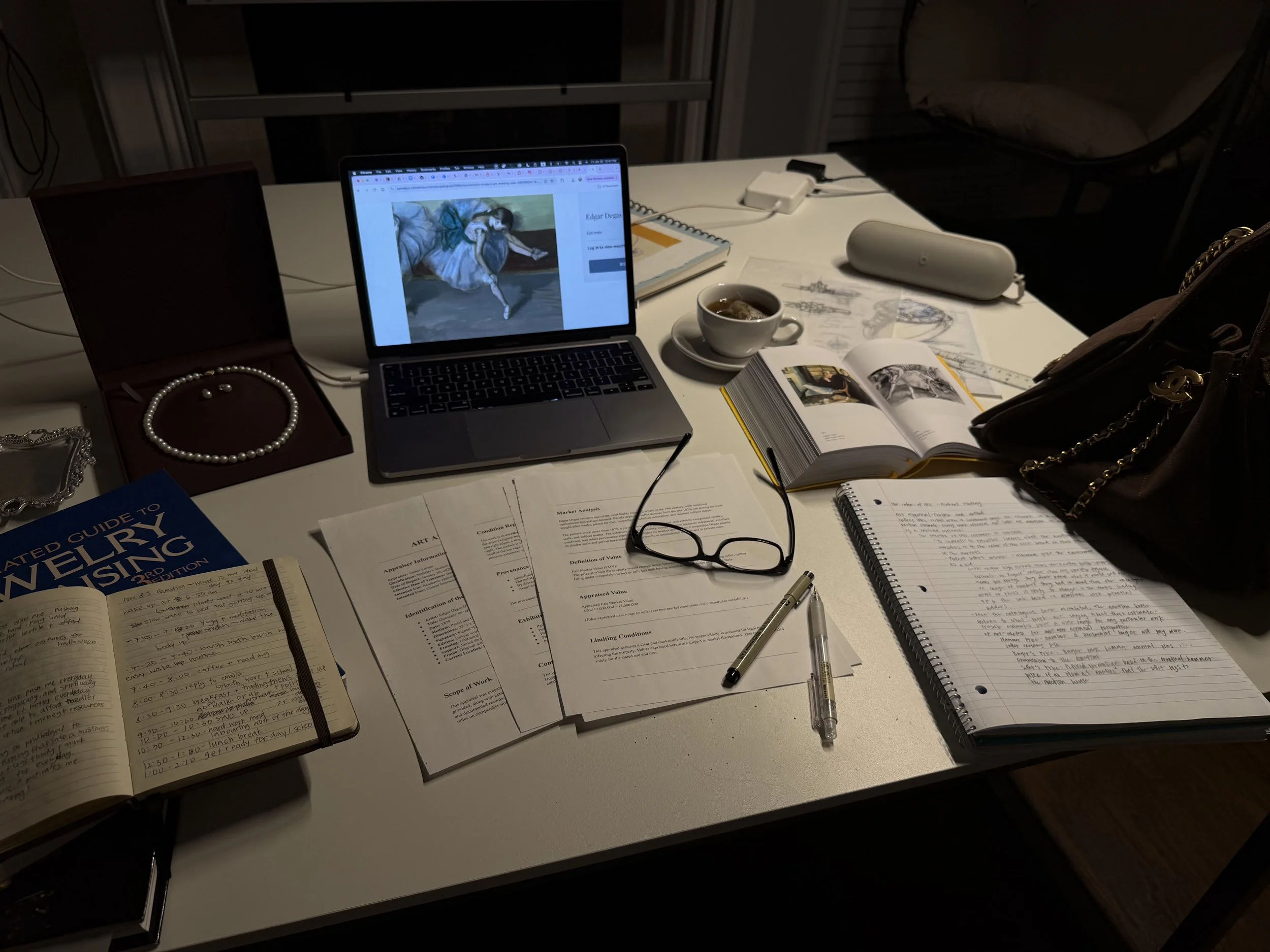
Work Desk Photograph © 2019 by SablesHouseCo.
To source is to move through the world differently. The practitioner trains their eye to not see beauty or rarity, but to read provenance: to understand an object as a document of time, of hands, and of intention. A Georgian parure does not simply appear at auction; it surfaces from a drawer, from an attic, from the settled estate of a family that no longer remembers what they have. A fragment of Roman glass does not announce its significance. It must be recognised.
This is the essential distinction between acquisition and sourcing. Acquisition is transactional. Sourcing is forensic, relational, and, when done well, almost literary in its demands. It requires that one ask not only what is this but where has this been, and why does it matter now.
The discipline draws on art history, natural history, materials science, legal frameworks governing cultural property, and a network of relationships built across years and across continents. It is, by necessity, interdisciplinary, and it is undermined the moment it becomes careless.
How the Process Begins: First Contact and Initial Assessment
A sourcing engagement at Sables typically begins not at an auction preview but far earlier, often through a private approach. An estate executor contacts us regarding a collection that has not been publicly assessed in decades. A collector wishes to acquire a specific category of object and has exhausted conventional channels. A family believes they may have something significant and does not yet know where to turn.
The first task is orientation. Before any formal assessment begins, a sourcer must understand the full context of what they are examining. This means reviewing any existing documentation: prior appraisals, insurance records, purchase receipts, correspondence, exhibition histories, and acquisition notes. These documents do not only support valuation; they begin to construct the chain of custody that is central to any serious transaction.
Where documentation is sparse or absent, the work becomes more interpretive. Physical examination takes precedence. The sourcer looks at construction methods, material composition, tool marks, surface patination, and signs of age-consistent wear. They assess whether what they are seeing is consistent with what the object is claimed to be. A signed piece is not authenticated by its signature alone; the signature must be consistent with the hand, period, and medium of the attributed maker, and that consistency must be corroborated through comparative study.
The Intelligence Beneath the Surface: Research and Verification
Once initial assessment is complete, the research phase begins. This is where the interdisciplinary demands of sourcing become most acute.
Consider a significant piece of antique jewellery. The stone alone requires gemological assessment: species identification, treatment detection, and, for coloured stones of consequence, origin determination through spectroscopic analysis. The mount demands a different literacy entirely: an understanding of period metalwork, of regional workshop traditions, of the stylistic signatures that distinguish a Parisian maison from a London house from a Florentine atelier. Hallmarks must be cross-referenced against period assay records. Construction techniques must align with the claimed date of manufacture. Two seemingly identical pieces may differ profoundly in value, cultural significance, and legal status. The untrained eye conflates them. The sourcer does not.
For natural history specimens, the research framework shifts but the rigour does not. A significant meteorite requires classification through mineralogical analysis to confirm its type and origin group. A fossil of museum quality demands documentation of its geological context, including the formation and stratum from which it was recovered, wherever that information is obtainable. In both cases, the sourcer must also navigate the legal landscape governing the collection and trade of natural specimens, which varies considerably across jurisdictions and has become substantially more complex in recent decades.
Heritage objects and historical artefacts introduce the further dimension of cultural property law. The 1970 UNESCO Convention represents a widely recognised benchmark for provenance standards in the international market, but national legislation frequently imposes stricter requirements, and bilateral agreements between countries can affect the legal status of specific categories of object. A sourcer who is not conversant with these frameworks is not merely professionally limited; they are a liability to their clients.
Throughout the research phase, Sables engages external specialists as warranted: independent conservators, institutional curators, legal counsel with expertise in cultural property, and scientific laboratories capable of performing material analysis. This is not a concession of uncertainty. It is the correct methodology. The most authoritative assessments are those that draw on the broadest and most appropriately qualified body of expertise.
Relationships as Infrastructure
No sourcing operation of genuine consequence operates in isolation. The market for rare and exceptional objects is, in the end, a market of people: private collectors with specific and sometimes eccentric tastes; estate executors navigating unfamiliar territory; scholars who know precisely what something is and are willing, under the right circumstances, to say so; conservators who have spent careers in the company of objects and notice what others miss.
These relationships are useful. They are, in a meaningful sense, the infrastructure of the discipline. A call taken, a connection made, a referral extended: these are the mechanisms by which exceptional objects find their way to the surface. They cannot be manufactured through marketing or compressed into a platform. They are built slowly, through demonstrated competence and through trust.
At Sables, the cultivation of these networks is understood to be as essential as any technical expertise. The sourcer who cannot move through both scholarly and commercial worlds with equal fluency is a sourcer operating at half capacity.
Appraisal, Positioning, and the Question of Market
Once research is complete, the sourcer must address a question that is deceptively simple: what is this worth, and to whom?
Valuation in the luxury sourcing context is not a formula. It requires an understanding of current market conditions, recent comparable sales, the specific appetite of likely buyers, and the effect of provenance quality on price. An object with an unimpeachable ownership history commands a premium that can be substantial. An object with gaps in its provenance, even when those gaps are explicable, will face resistance in the most demanding segments of the market.
Positioning follows from valuation. Sables advises clients on whether an object is best placed through private treaty sale, consignment to a specialist auction house, direct approach to an institutional buyer, or retention pending more favourable market conditions. Each path carries different implications for timing, confidentiality, price realisation, and the long-term legacy of the object. There is rarely a single correct answer, and the sourcer's role is to ensure that the client understands the full range of options before committing to any one of them.
Against the Shortcut
The contemporary market, accelerated by digital platforms and the democratisation of access to auction results, has created conditions in which shortcuts are tempting and often rewarded, at least in the short term. Objects are bought on superficial assessment and sold with inflated claims. Provenance is asserted rather than demonstrated. The difference between a genuine rarity and a convincing facsimile is glossed over in the rush to transact.
Sables takes the opposing view. The shortcut is a failure of respect for the object, for its history, and for the client who will ultimately bear the consequences of insufficient rigour. An object misidentified is a client misled. A provenance uninvestigated is a liability deferred, not resolved.
The art of sourcing, practised with integrity, is slow. It involves refusal as often as acquisition. It involves telling a client that what they wish to sell is not what they believe it to be, or that the object they wish to acquire is not worth the price being asked. This is not a comfortable function. It is, however, an indispensable one.
What Lasts
The objects that Sables handles, works of art, historic jewels, designed objects of consequence, specimens drawn from the natural world, share a quality that transcends category: they are irreplaceable. There will be no second example, no reissue, no comparable substitute. This places a particular weight on the act of sourcing. To bring such an object to market, to place it in the hands of a new custodian, is to participate in a chain of stewardship that extends backwards through history and forward into an unknowable future.
That is not a responsibility to be taken lightly. It is, on the contrary, the reason this work demands the highest standards of scholarship, ethics, and judgment. It is why the art of sourcing, unglamorous in its mechanics and invisible in its best execution, remains the foundation on which every serious transaction rests.
To source well is to know what you are looking at, to know what it cost the world to produce it, and to ensure that its next chapter is worthy of all that came before.
