Indian Steel Dagger

$8,500.00
Request Estimate

Late 19th Century

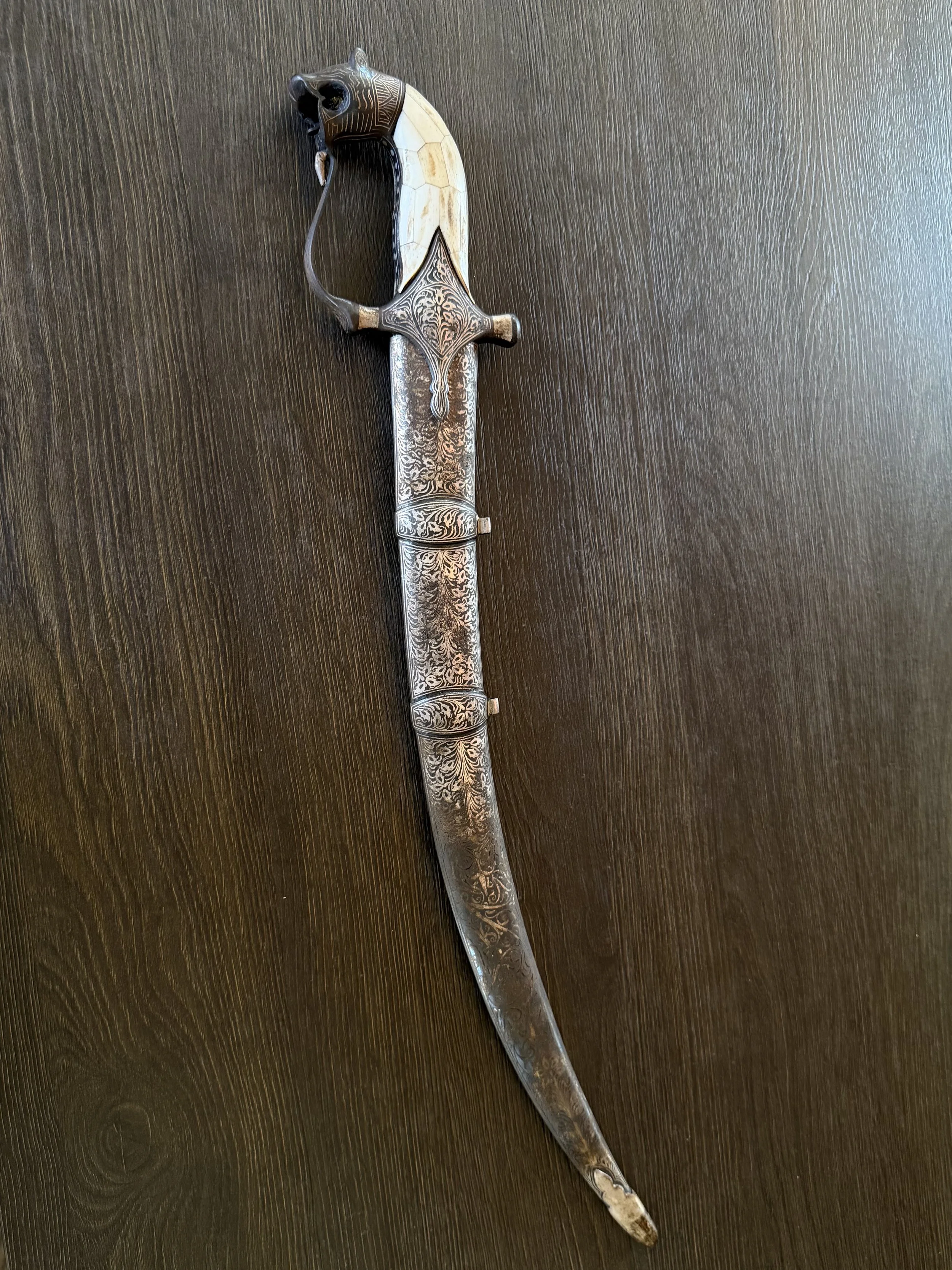
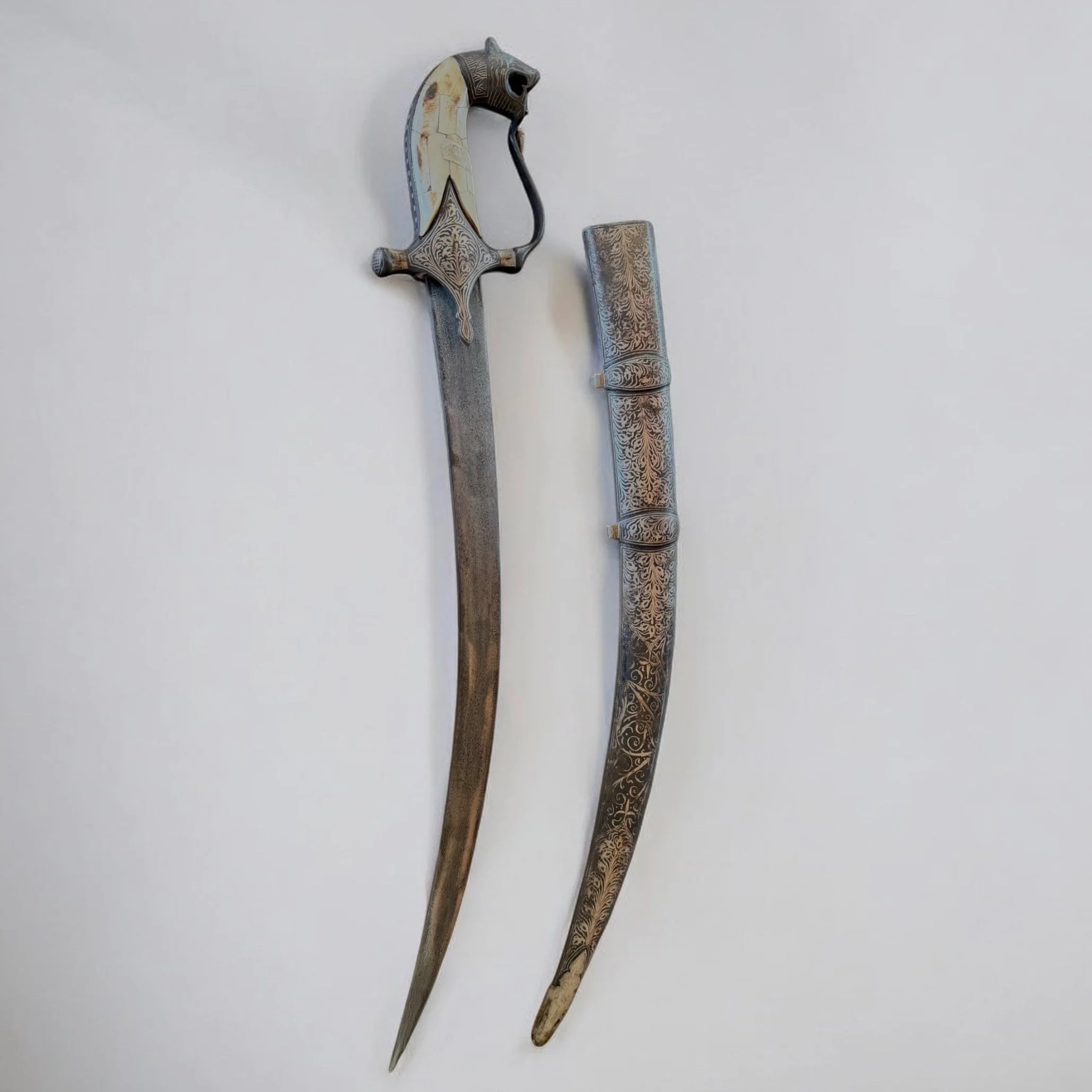
A finely crafted late 19th century Indo-Persian Mughal-style ceremonial kirpan dagger of exceptional aesthetic quality, featuring a gracefully curved Damascus steel blade with a deep, fluid profile and refined taper.

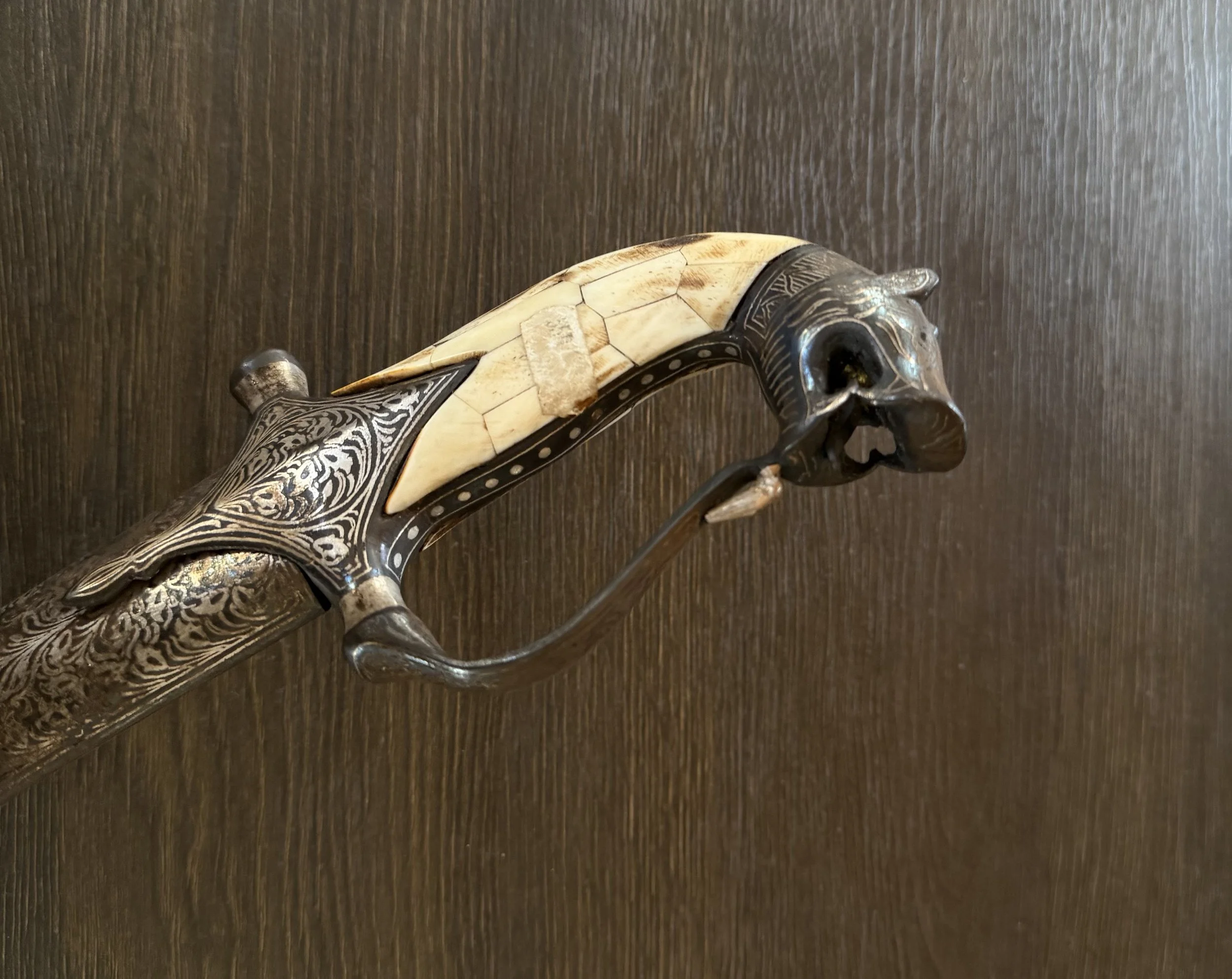
The piece is distinguished by a sculptural lion head hilt, rendered with expressive detail and fitted with bone grip panels aged to a warm, natural patina. The form reflects traditional Indo-Persian craftsmanship where symbolic animal motifs denote strength, guardianship, and noble authority.

The steel blade is hand-forged in a patterned Damascus construction, exhibiting subtle surface movement consistent with period forging techniques. The blade retains a strong curvature and elegant line, characteristic of ceremonial and courtly weapons rather than utilitarian battlefield forms.

The accompanying scabbard is richly decorated throughout with intricate silver koftgari work over a dark steel ground, incorporating dense vegetal and arabesque motifs. The ricasso and upper fittings continue the same decorative language, enhanced with niello-style contrast detailing, suggesting workshop-level refinement and skilled artisan execution.

This piece presents as a ritual or ceremonial Indo-Persian court dagger, likely intended for display or status symbolism within a noble or military household.

Late 19th Century

A finely crafted late 19th century Indo-Persian Mughal-style ceremonial kirpan dagger of exceptional aesthetic quality, featuring a gracefully curved Damascus steel blade with a deep, fluid profile and refined taper.

The piece is distinguished by a sculptural lion head hilt, rendered with expressive detail and fitted with bone grip panels aged to a warm, natural patina. The form reflects traditional Indo-Persian craftsmanship where symbolic animal motifs denote strength, guardianship, and noble authority.

The steel blade is hand-forged in a patterned Damascus construction, exhibiting subtle surface movement consistent with period forging techniques. The blade retains a strong curvature and elegant line, characteristic of ceremonial and courtly weapons rather than utilitarian battlefield forms.

The accompanying scabbard is richly decorated throughout with intricate silver koftgari work over a dark steel ground, incorporating dense vegetal and arabesque motifs. The ricasso and upper fittings continue the same decorative language, enhanced with niello-style contrast detailing, suggesting workshop-level refinement and skilled artisan execution.

This piece presents as a ritual or ceremonial Indo-Persian court dagger, likely intended for display or status symbolism within a noble or military household.

  • Description:

    Origin: Indo-Persian / Mughal Influence
    Date: Late 19th Century
    Materials: Hand-forged Damascus steel, bone, steel, silver koftgari decoration
    Type: Ceremonial kirpan / dagger with scabbard
    Overall Length: 24 1/4 in.
    Blade Length: 17 1/2 in.

  • This piece demonstrates a strong Indo-Persian influence with clear Mughal aesthetic continuity in both form and ornamentation. The surface is decorated with a high-quality silver koftgari overlay, featuring dense foliate engraving and a consistent, skilled hand throughout. The Damascus-style blade shows visible forging character consistent with late nineteenth-century workshop production, reflecting both traditional technique and period manufacture. A lion head terminal at the hilt suggests symbolic or courtly significance rather than practical battlefield use. The bone grip sections exhibit natural age toning and surface wear consistent with period handling and long-term use. The scabbard and blade present as a matched set, although their original pairing cannot be fully verified without metallurgical analysis. Overall, the composition indicates a ceremonial or status object, likely commissioned or produced for elite presentation purposes.

  • This piece should be understood as an antique Indo-Persian decorative and collectible object rather than a functional weapon in contemporary use. Collector interest is typically driven by its preserved aesthetic alignment with late nineteenth-century Mughal-inspired craftsmanship, as well as the visibility of traditional decorative techniques such as koftgari work and forged steel construction.

    Tier II — Established Market / Antique Decorative Object

    The piece displays an age-consistent patina throughout both metal and organic components, consistent with long-term preservation. Minor oxidation and surface wear are visible on the blade, in line with antique steel storage conditions. The koftgari silver overlay remains largely intact, with expected softening and wear in high-contact and exposed areas. The bone grip sections show natural ageing, including minor surface fissuring consistent with period materials. The scabbard retains strong structural integrity, with decorative detailing remaining well preserved and legible.